
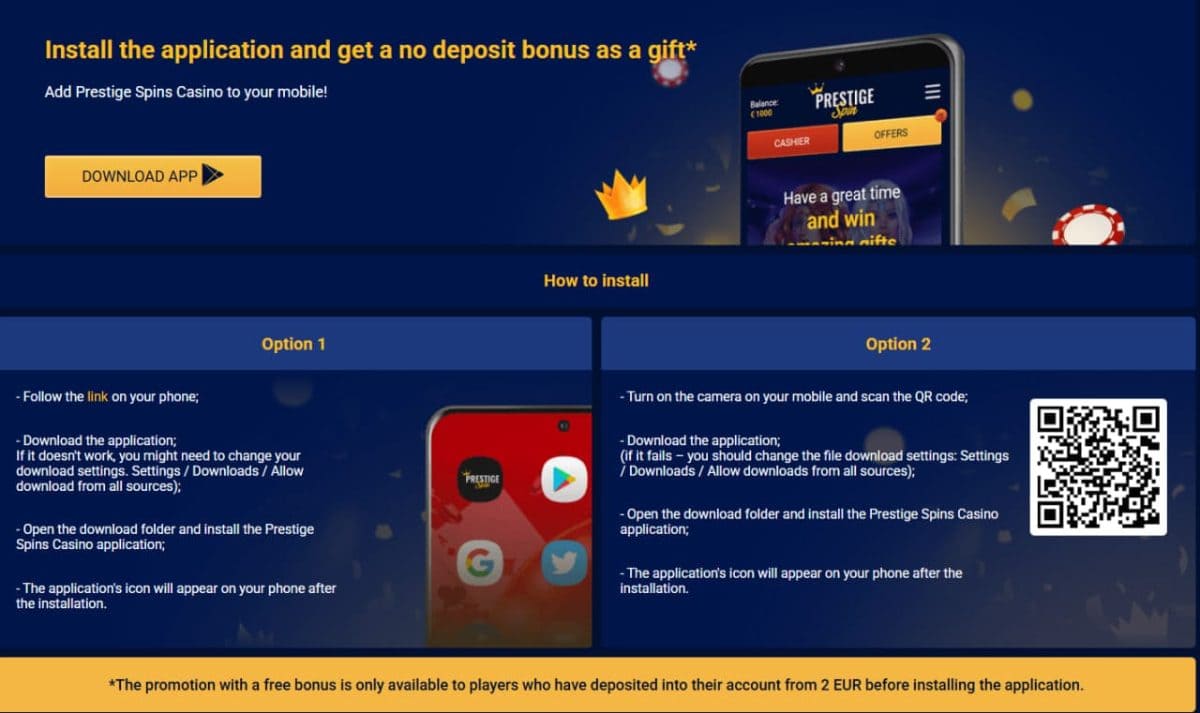
Prestige Spin Casino on a handset — three viable routes into the same offshore lobby: the standard browser path, an iOS home-screen shortcut, plus a downloadable Android binary distributed through the operator's own portal. Pick whichever access matches your tolerance for sideload distribution; gameplay sits identical across every route because the underlying studios push the same HTML5 builds regardless of wrapper.
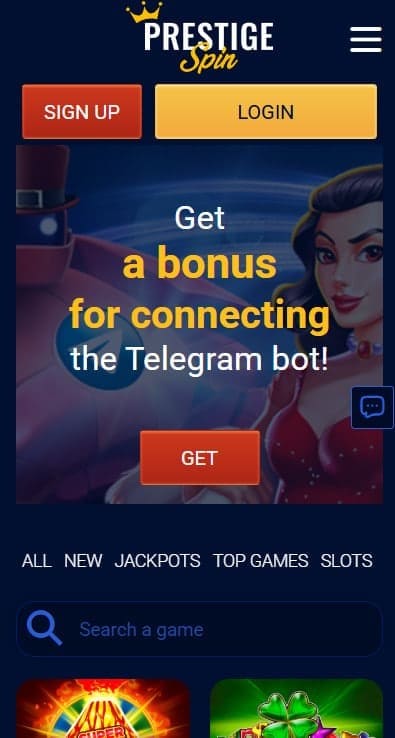
Handset delivery at this brand splits across two distinct routes — a downloadable Android binary distributed directly through the operator's own portal, plus an iOS web-app shortcut handled via Safari rather than the App Store. That combination sits unusually for the offshore segment, where most peer venues skip native packaging entirely because both Apple's marketplace and Google Play bar real-money gambling apps under their UK distribution policies. Sideload availability raises its own set of security questions worth working through carefully before any reader chooses that route over the regular browser session, which remains the third (and arguably safest) access path.
Across our review window we tested the lobby on an iPhone 14, a Pixel 7, plus an older Galaxy A53 running Android 10 to evaluate behaviour across device generations. Browser-based access produced consistent results across all three handsets; the APK route ran on the Android devices once permissions were granted; the PWA shortcut on iOS delivered something close to a standalone app experience without invoking any install step. Coverage below walks through each path practically: when each makes sense, what to verify before sideloading, how the home-screen shortcut compares to a packaged binary, performance under variable mobile signal, plus the data and battery considerations any extended session needs to factor in.
| Access Path | How It Works | Best Suited For |
|---|---|---|
| 🌐 Direct Browser Session | Open Safari, Chrome, Firefox, or Edge and navigate to the operator domain — zero install footprint | Occasional visitors plus anyone wanting the lightest possible footprint on the device |
| 🏠 Home-Screen Shortcut (iOS PWA) | Add a bookmark through Safari's share menu — launches the lobby inside a dedicated tab from a single tap | iPhone users who want near-application behaviour without sideloading anything |
| 📲 Android APK Install | Download the operator-published binary from the official portal, enable installation from trusted sources, then run the package | Regular Android users prepared to accept the security implications of sideload distribution |
One observation worth flagging immediately: the existence of an operator-distributed APK changes the security calculus relative to brands that skip native delivery entirely. The downloadable file itself can sit legitimate, but the wider problem inside this market involves third-party mirrors substituting trojanised binaries for genuine downloads. Anyone choosing the sideload path needs to verify the source URL belongs to the operator's own domain rather than an aggregator, fan site, or unverified mirror — repackaged Android files carrying credential-stealing or transaction-redirection modifications represent a recurring threat across the wider non-UKGC sector.
Minimum platform requirement runs at Android 8.0, which covers the great majority of devices still in active circulation across British users. Storage footprint sits light — typical install size sits well below 50MB based on what comparable offshore-segment APKs occupy. Updates arrive in-app rather than through the marketplace, which means the application checks for a new build on launch and prompts the user to download replacement files when the operator pushes a revision. That pattern keeps the binary current without requiring repeat downloads from the portal.
One specific security recommendation belongs alongside the install steps: after granting "Install unknown apps" permission to the browser for the download, revoke that same permission once installation completes. Leaving the toggle enabled creates an attack vector where any subsequent malicious download from the same browser can install without further user confirmation — a small but meaningful hardening step that costs nothing and removes the residual risk.
Tapping the shortcut takes the user straight into the lobby from a single gesture, with Safari handling session-cookie persistence, identity-document uploads via the camera, plus streamed-room audio routing transparently. The browser address bar remains visible across the top — a small cosmetic compromise for the security benefit of avoiding sideload entirely. iOS users gain near-application behaviour through this path without committing to anything outside Apple's normal security envelope, which is why we generally recommend it over more aggressive install routes.
For readers uncomfortable with sideloading binaries or building home-screen shortcuts, opening the operator's lobby inside a standard mobile browser delivers the full feature set without any commitment beyond the URL itself. Safari on iOS, Chrome on Android, Firefox or Edge across either platform — every modern engine renders the responsive HTML5 layout cleanly. Cashier flows, identity submission, streamed rooms, plus the recurring promotional cadence all operate identically to what the dedicated APK wrapper presents.
Net practical difference between browser and packaged routes: the wrapper reclaims roughly 8–12% of vertical screen area (no browser chrome) plus enables push notifications about active campaigns, while the browser path costs that visual real estate but removes any sideload-related security exposure. For occasional play or sessions running under thirty minutes, the trade-off lands clearly in favour of staying inside the browser. Regular daily users may prefer the wrapper's slightly more polished presentation, provided they have verified the binary source carefully.
| Interface Element | Desktop Behaviour | Handset Behaviour |
|---|---|---|
| Top Navigation | Horizontal menu bar with every category label visible simultaneously | Collapses behind a hamburger glyph accessible from the upper-left corner |
| Game Lobby Grid | 4–6 thumbnail columns per row depending on the viewport width | 2–3 thumbnails per row with infinite-scroll pagination as the user swipes downward |
| Live Dealer Layout | Stream window plus side-panel betting controls displayed inline | Portrait orientation stacks video above the controls · landscape rotation restores side-by-side presentation |
| Cashier Forms | Multi-column field arrangement with the amount selector visible alongside method icons | Single-column stacked layout · the on-screen keyboard occasionally overlaps confirm buttons during amount entry |
| Promotional Banners | Carousel display across the homepage's upper section | Compressed banner stack · campaign cards display in vertical sequence rather than rotating |
| Support Widget Position | Floating bubble fixed to the lower-right corner | Identical widget with reduced footprint to preserve visible playing surface |
Loading the lobby cold across a 4G connection completed inside three to five seconds across our sessions — broadly consistent with what current handsets achieve against responsive casino sites generally. Streamed dealer rooms demand more headroom: clean playback held above roughly 5 Mbps downlink, with occasional buffering across weaker signal patches. Wi-Fi sessions handled everything without complaint, including extended live blackjack runs at full HD plus game-show sequences across British evening windows when operator traffic concentrates.
Battery drain runs at the standard level for extended browser sessions involving live video — roughly 12–18% per hour of active streamed play on recent iPhones or flagship Android handsets. Older devices burn through power faster than that figure suggests. Closing background applications plus reducing display brightness extends the effective playing window if the session needs to run across longer stretches without charging.
The packaged APK route delivered marginally faster initial load (the wrapper avoids the browser's cold-start overhead) but did not produce any meaningful difference once the lobby had cached itself. Gameplay performance after the first minute sat indistinguishable across browser and APK paths during our testing — the studios shipping the games push the same HTML5 builds regardless of whether the rendering happens inside Chrome or a dedicated wrapper.
Pure slot play sits light on bandwidth — roughly 50 to 100 MB per hour, comfortably inside the great majority of monthly mobile allowances. Streamed dealer sessions shift the picture meaningfully: figure between 500 MB and 1 GB per hour at standard HD resolution. Readers on capped plans should monitor live-table activity carefully or restrict streaming to Wi-Fi where the connection is available. Crash games and multiplier formats sit somewhere between those two figures because their visual layer carries less video than a streamed table but more animation than a static slot reel.
Audio mixing through Bluetooth headphones works reliably across both platforms during streamed play, though we observed occasional latency drift across game-show formats where the dealer voiceover sits central to the mechanic. Switching to wired earbuds eliminates that variance entirely if the lag becomes bothersome enough to affect engagement.
Password recovery routes through an email-based reset link. Tapping "Forgot password" triggers a message sent to the address on file. Given that platform-level 2FA does not surface among the visible security options, we strongly recommend storing credentials inside a reputable password manager (Bitwarden, 1Password, iCloud Keychain, or equivalent) paired with a long, randomly-generated unique string rather than relying on memory or browser autocomplete. Gambling-account credentials sit among the higher-value phishing targets across the wider internet, and defending them properly falls on the user because the operator's own controls in this area run thinner than they should.
The recurring promotional structure at this brand activates through bonus codes entered inside the cashier form during qualifying deposits. The same flow operates identically across browser, PWA, and APK access:
One specific practical note worth flagging: the on-screen keyboard occasionally covers the bonus-code field after the deposit-amount input grabs focus. Tapping "done" or dismissing the keyboard manually before navigating to the code field resolves the overlap cleanly. The cashier remembers entered codes across browser-session navigation, so accidentally swiping away from the page does not require re-entry if the user returns to the form inside the same tab.
Three viable paths exist. Browser-first delivers full feature parity with zero install commitment plus zero security exposure — our default recommendation for occasional play or for any reader uncertain about sideload trustworthiness. The iOS home-screen shortcut adds near-application behaviour for iPhone users without invoking install steps. The Android APK delivers the wrapped experience for regular users prepared to verify the binary source carefully plus revoke "Install unknown apps" permission after the install completes. Each path produces identical gameplay because the underlying studios push the same HTML5 builds regardless of wrapper.
For British readers used to UKGC-licensed casino applications with their integrated GamStop hooks and biometric login options, this property's mobile delivery will feel less refined. The lobby itself functions cleanly across every route we tested, but the security envelope around sideload distribution shifts more responsibility onto the user than what Commission-supervised venues typically expect. Treating the browser path as the default plus the APK as an optional convenience after careful source verification represents the safest pragmatic approach.
The file distributed through the operator's own portal can sit legitimate, but the wider risk involves third-party mirrors substituting trojanised binaries. Anyone choosing the sideload path needs to verify the download URL belongs to the operator's own domain rather than an aggregator or fan site, then revoke the "Install unknown apps" browser permission once installation completes. Browser-based access remains the lower-risk default for users uncertain about source verification.
No native iOS binary distributes through Apple's marketplace because the platform restricts real-money casino installations across the UK market. iPhone and iPad users access the brand via a Progressive Web App shortcut added to the home screen through Safari's share menu. That route delivers near-application behaviour without invoking any sideload step.
Yes — slots, streamed rooms, crash titles, table games, plus the integrated sportsbook all render through the responsive layout regardless of access route. Live-dealer presentations may display minor layout differences versus desktop (stream above controls in portrait orientation rather than side-by-side), but functional access stays complete across every content category.
Roughly 500 MB to 1 GB per hour at standard HD resolution for live-table sessions. Slot-only play sits substantially lighter at 50–100 MB per hour. Readers on capped plans should restrict streamed rooms to Wi-Fi where possible. Crash games and multiplier formats fall between those two ranges because their visual layer carries less video than a streamed table but more animation than static slot reels.
Yes — the responsive cashier opens the device camera or photo library when document submission is requested. Capturing the image at the moment of upload generally produces cleaner results than transferring scans from a laptop, because lighting and orientation control more easily on a handheld device against a flat surface.
RNG slot outcomes resolve server-side, so the spin completes regardless of whether the device stays connected through the cycle. Reopening the lobby restores the session and credits any wins. Streamed rounds resolve based on the dealer's actual outcome at the table; the player receives whatever the round delivered, win or loss, once reconnection occurs.
2FA does not appear among the visible account-level options at this brand — a notable security gap relative to UKGC-supervised competitors. Defensive responsibility falls on the user: store credentials inside a reputable password manager paired with a long, randomly-generated unique string, plus consider rotating that password periodically.
Across our review window we did not observe device-segmented offers specific to mobile access. The welcome architecture, recurring reload mechanics, plus the seasonal codes that surface through email or the lobby banner apply identically regardless of access method. That balance could shift with future operator campaigns, so checking the promotions tab inside the account before depositing remains the sensible step.
Shortcuts behave like bookmarked tabs launched in dedicated windows. They retain access to browser cookies, autofill data, plus the device camera for identity uploads, while running inside the browser's security sandbox rather than as a separate installed application. The packaged APK runs outside that sandbox as a fully installed binary with its own storage allocation, permissions footprint, plus update channel. Functional access stays identical across both routes; security exposure runs higher on the packaged path because sideload distribution sits outside the marketplace verification chain.
No. Any "Prestige Spin Casino app" file distributed outside the operator's own domain carries serious risk of being repackaged with credential-stealing or transaction-redirection modifications. Use the operator-published download directly, or stay with the browser route plus a home-screen shortcut — the gameplay experience matches across all paths, and the security profile sits incomparably better on either of the verified routes.